General Information
Busbar General Information
The Busbar Trunking System was first introduced in America during the 1930s to meet the requirements of the construction industry, with the advent of skyscrapers and the development of production technologies in factories.
European countries and Japan started using this system in the early 1950s, however during the 1970s EAE Electric started its own production and the use of busbar trunking systems in Turkey began.
Types of Busbars Accordıng to the Current Intake Poınt
What is a bolt-on busbar?
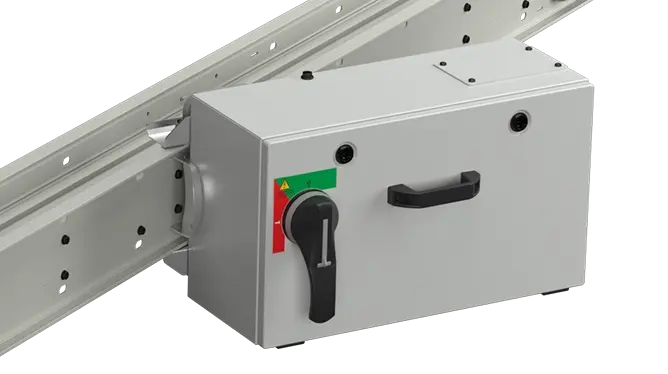
Bolt-on Busbar System: Busbar systems that allows the distribution of electrical current via current supply tap off boxes junctures positioned in the busbar system.
Bolt-on: Used where current needs to be supplied from junctures positioned in busbar system and direct supply is executed.
plug-in busbar
What is a plug-in busbar?
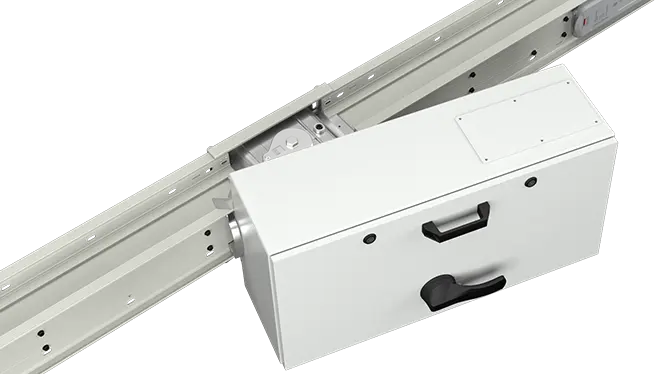
Plug-in Busbar System: Busbar trunking systems that allows the receiving of electrical current via current supply tap off boxes on current supply (Plug-in point) windows on the casing of the busbar system.
Plug-in: Used where current is to be supplied from junctures positioned in busbar systems and plug-in window. (Only straight modules)
Types of Busbars According to Structure
What is Air Insulated Busbar?
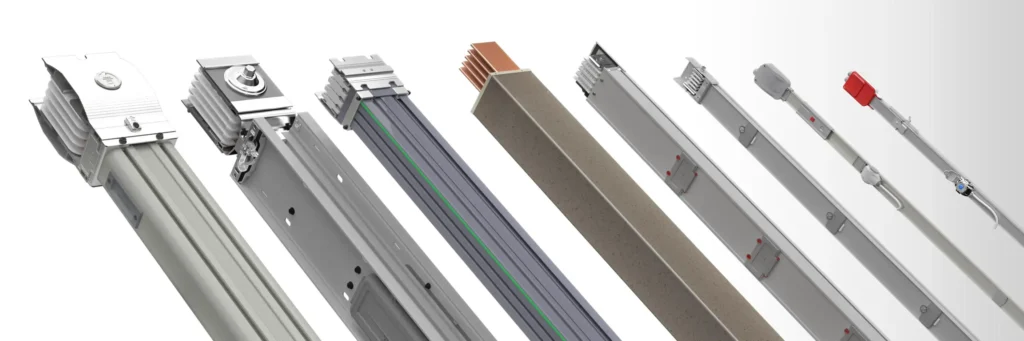
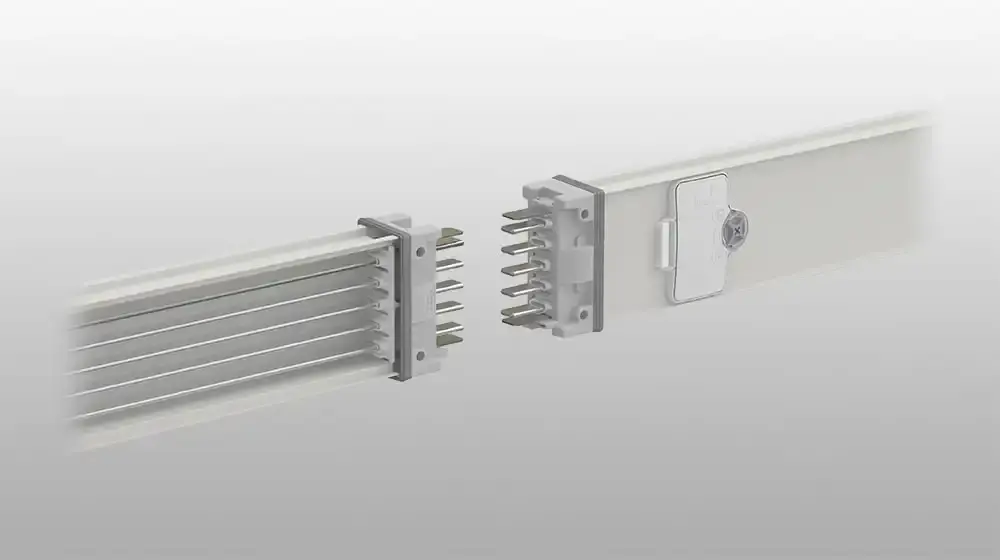
The most distinct specification of the air insulated Busbar system is that there is a certain gap between the conductors and the Busbar system functions in a closed metal body in an insulated environment provided with air.
The conductors (Aluminum or Copper) are not connected to each other as in the compact Busbar system.
If the conductors used in the Busbar system are in the range of 25A to 63A; conductors are placed in an insulated sheath (such as E-Line KY-S, E-Line DL/SL, E-Line KAM/KAP).
If the conductors used in the Busbar system are 100A amperes and above; it is placed on post insulators at certain intervals (such as E-Line MK, E-Line KO-II). These systems are generally produced in a multiple tap-off distribution Busbar structures.
Compact Busbar
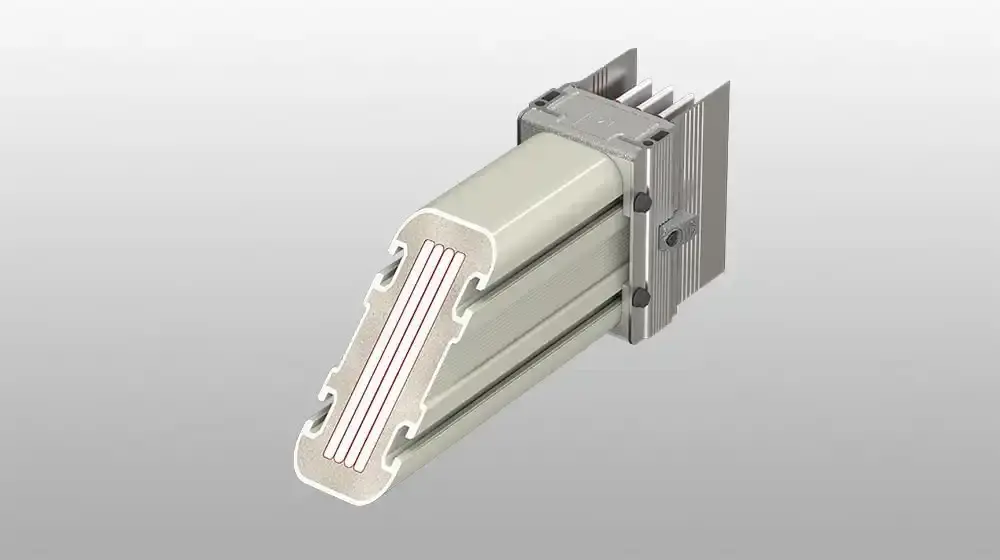
What is Compact (Sandwich Type) Busbar?
These are the compact (Sandwich Type) Busbar systems, which are the latest stage in which robotic technology is used in its production.
The main specification of the compact Busbar system is that after the conductors (Aluminum or Copper) are wrapped with insulation materials (primarily B class polyester film, which is coated with an epoxy or polypropylene insulating material and temperature resistant), they are placed in the metal body in the form of sandwiches without any air gap.
With the compact structure, the dimensions are minimized as much as possible according to the capacity of the energy carried. Since the distance between the conductors is minimized, the inductive reactance is reduced and accordingly the voltage drop is reduced.
Thanks to the housing that acts as cooling, heat transfer is supplied in the most ideal way. Sandwich Type Busbar systems are produced from 400A and above.
Features
Busbar Tap-Off Boxes
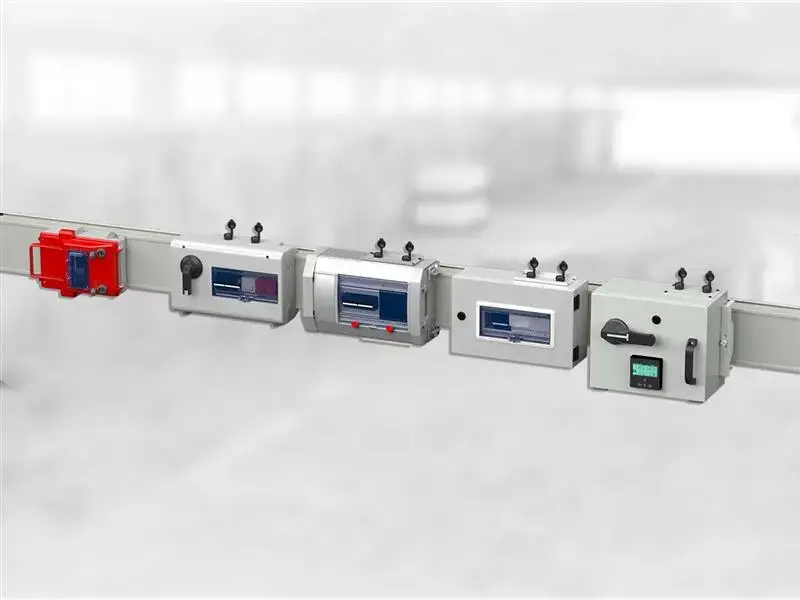
EAE Busbar Tap-Off Boxes; offers tap-off boxes with plastic, aluminum and sheet metal housing that can be specially designed with all kinds of complementary components in line with the desired demands.
Questions
Frequently Asked Questions About Busbar Systems
The busbar system is used to transfer electrical energy to a vertical or horizontal point along the route within the facility, starting from a point such as a transformer, generator or panel, or to distribute energy to the loads within the facility by taking energy from the current receiving points utilizing tap off boxes.Busbar systems are widely used in high-rise buildings, factories, workshops, assembly lines, warehouses, stations, hotels, airports, petrochemical plants, data centers and supermarkets, etc. that require medium and low voltage current distribution.
The busbar system is a system that consists of straight lengths, supply elements, turning elements, panel and transformer modules, T-connectors, reduction and expansion transition modules.
Maintenance of the busbar system should be externally inspected annually. Busbar maintenance should never be done under electrical load. It should be ensured at every stage that all electrical connections are disconnected. Since energizing a busbar system that has been contaminated by water or moisture will damage the system and the employees. Precautions must be taken; tests must be carried out and possible causes must be eliminated. IEC 61439-6 standards, safety-related specifications in the country should be followed and implemented by all operating services. Since cleaning and other materials containing hydrocarbons that can be used during maintenance may have harmful effects on plastic materials, EAE must be contacted before use. EAE Busbar Systems operate silently under normal operating conditions. There may be a very slight buzz in some installations. This sound is impermissible; It may occur due to the fact that the joint points, metal parts are not assembled according to the user manuals. The system must be overhauled by turning off the energy and the problem must be eliminated. Any dripping or moisture that may appear on the busbar modules should be eradicated from the environment without delay and the cause should be eliminated.
Busbar systems are extremely easy to install thanks to their modular design. However, like all electrical systems, it is recommended that the installation be carried out by qualified personnel who are experts in their field and have received the necessary occupational health and safety training. Pre-assembly, assembly steps and what to do post assembly are explained in the manuals of the relevant products. Before commencing the assembly without reading the instructions or assembly manual.